

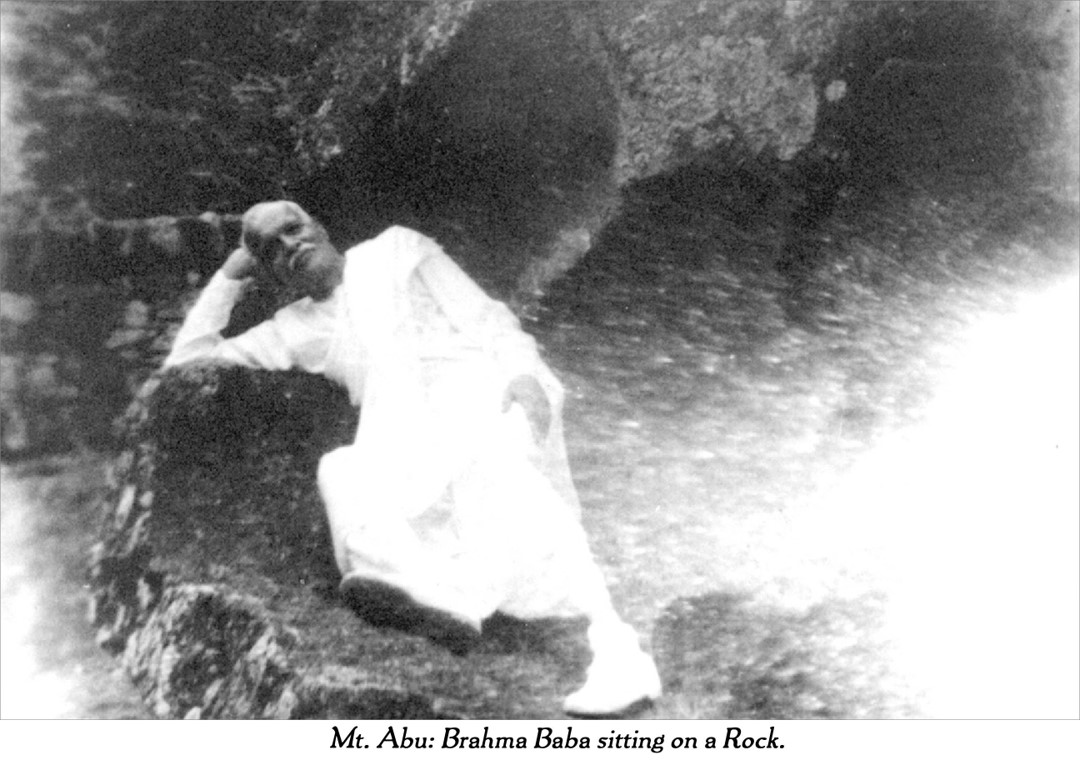

Baba says, “I enter the chariot of the one who was the number one worthy-of-worship one became the number one worshipper.”
Many question: Why does God take the support of this particular chariot? Why not someone else’s chariot? Even if God has to come in Bharat, there are so many souls in Bharat, so many eminent ones. Bharat is a land of sages, of great thinkers, scholars etc., wouldn’t one of them be more appropriate choice for God Himself!? Only God can explain why He chooses the chariot that He does. He cannot enter the body of a sage or a great soul, He explains, because they don’t belong to the family path; they belong to the path of isolation. God comes to give the fruit of devotion and so He enters the chariot of a devotee to do so. But why this devotee? There are so many well-known devotees in Bharat! However, explains Baba, those devotees were devotees only in one or two births; God wouldn’t enter such devotees. “I enter the one who began devotion.“, He explains. Devotion began in the copper age and the one whom God enters is not just the first devotee, the one who began bhakti but he is also someone who continued to perform bhakti for birth after birth for a whole half a cycle. “This one used to perform a lot of devotion and he has to receive the fruit of his devotion.“, explains the Father.
Then, He says one more thing that offers insight into His choice. He says: “This one surrendered to Me, He gave Me everything.“
Sure, that refers to Father Brahma’s surrender in this birth but it also reveals his sanskar in bhakti. There are two types of bhagats. 1) those who want to attain God and 2) those who want to attain something from God. Most bhagats belong to the second category and when they become Brahmins, those same sankars get transferred over into Brahmin life. Many think that because they now know God, all their desires ought to be fulfilled; otherwise what’s the point of knowing God! So they expect Him to help them in their business, with winning that new contract, with securing that new home in that neighborhood etc. When they need God to help them with a situation or a problem, they sit in yoga for ‘x’ hours daily for ‘y’ number of days. This is no different than performing rituals in bhakti to impress God. Once the problem is resolved, they promptly return to their old way of life. Sure, they may wake up for amritvela, attend murli and even serve at the center but there isn’t that intensity or remembrance; God has been relegated to the back of the mind. Sometimes, I don’t want lokik things but I want to be put in the front in service. In other words, I treat service as a career path and expect God to place me in the front, on stage based on ‘my’ skills. I want Him to make the instrument teacher like me, I want to be recognized and praised for all the great ‘service’ I do. Then, when this doesn’t happen, I sulk with God and complain: “Baba, I follow all the disciplines, I do so much and yet, why don’t I receive the credit I deserve?” It’s as if I did God a favor by following the disciplines and now I expect Him to return the favor. This is selfish bhakti transferred over into gyan.
Father Brahma belonged to the first category of bhagats. He performed bhakti to attain God, not for what he could attain from God. If one were to consider Father Brahma’s circumstances when he started bhakti, one finds that there was no real need for anything. As God explains, bhakti began in the copper age. Then, there still wasn’t any sorrow; sorrow begins gradually later. “There, you still have plenty of wealth. You had very big diamonds and jewels which no one could put a value on.“, explains Baba. And yet, the path of devotion began. “You build temples. First, there is the Somnath Temple. There were so many diamonds and jewels in it.“, teaches Baba. When there isn’t really any sorrow, no lack of anything, so much abundance, then why did Father Brahma begin bhakti? Clearly, it wasn’t to attain anything, it was out of pure, unadulterated love for the Father who made him who he is. So it wasn’t just that he was the first bhagat but he was also the first-class bhagat.
Even in his last birth, before becoming a Brahmin, Father Brahma, known as Dada Lekhraj at the time, was a staunch devotee- still not for attainment but out of love for God. He was thirsty for knowledge, to know God. He performed immense charity in the name of God, maintained respect and regard for one and all. As a result, he was greatly loved and respected in society. Then, when He came to Baba, his very first step was, predictably, complete surrender. Not only renunciation of the body and lokik relations, but the greatest renunciation, the first renunciation, was that of surrendering his mind and intellect. That meant that in every action, at every moment, there was only the awareness of the Father and shrimat in his mind and intellect. He constantly considered himself to be an instrument and was detached and loving in every action. Even when he gave his wealth to God’s task, there wasn’t even a thought that ‘I gave my wealth to God’; he never considered it to be his wealth in the first place. In service, he continued to place the children in front and believed that the children were ahead of him in everything; this was his level of humility. No matter what the situation or crisis or opposition he faced, he never ever sulked with God or complained to Him. On the contrary, he remained faithful and fearless. His attitude was: “He is the Protector and Benefactor, my life is in His hands, He is in charge, He will take care.” Such faith can only come when there is deep love and complete surrender.
Father Brahma never was and still hasn’t tired of praising the Father and instilling love for the Father in the children’s hearts: “Someone who is loved is referred to as: Jewel of the eyes, or loved more than life. This Father is the most beloved. Love for Him should be such, don’t even ask! The most beloved Father is teaching us. He is the Ocean of Knowledge, Happiness and Love. There must be so much love for such a most beloved Father! He does so much altruistic service of the children. He makes you become like diamonds. Baba is so sweet. He is so egoless and serves you children and so you children should also serve Him with so much love. You must follow shrimat.“, he teaches us children. Remember Whose children you are!, He reminds me daily. Sure, Maya defeats me sometimes, but I still have found the Father, I am still His child! And so, if anyone were to ask me: “Are you happy and content?”, Father Brahma says, respond to them by saying: “Why are you asking me about my welfare? We are God’s children! I was concerned to find the One who resides beyond, in the brahm element. Now that I’ve found Him, what else would I be concerned about?” Such is Father Brahma’s love for the Father that he considers it an insult to the Father if His children are sad or discontent about anything. His attitude: “Even deities have no worry or concern, so then as God is higher than the deities, how can the children of God have any concerns! Baba is teaching us! He is our Teacher and Satguru! Baba is placing crowns on our heads!“
In a world that has become increasingly tamopradhan, where a son is impatient for his father to retire or die so that he can receive his property, where children neglect their parents when they no longer need them, Father Brahma loved his Father, whole heartedly, throughout the whole cycle. The Father comes and shows me how Father Brahma surrendered to Him. “He gave Me everything.“, He explains and in return, Baba makes him the king of the world, the number one worthy-of-worship who then also becomes the number one (the first, the best, the truest) worshipper.
 SHIVA DARSHAN